
 لالعربية


I. Product Introduction
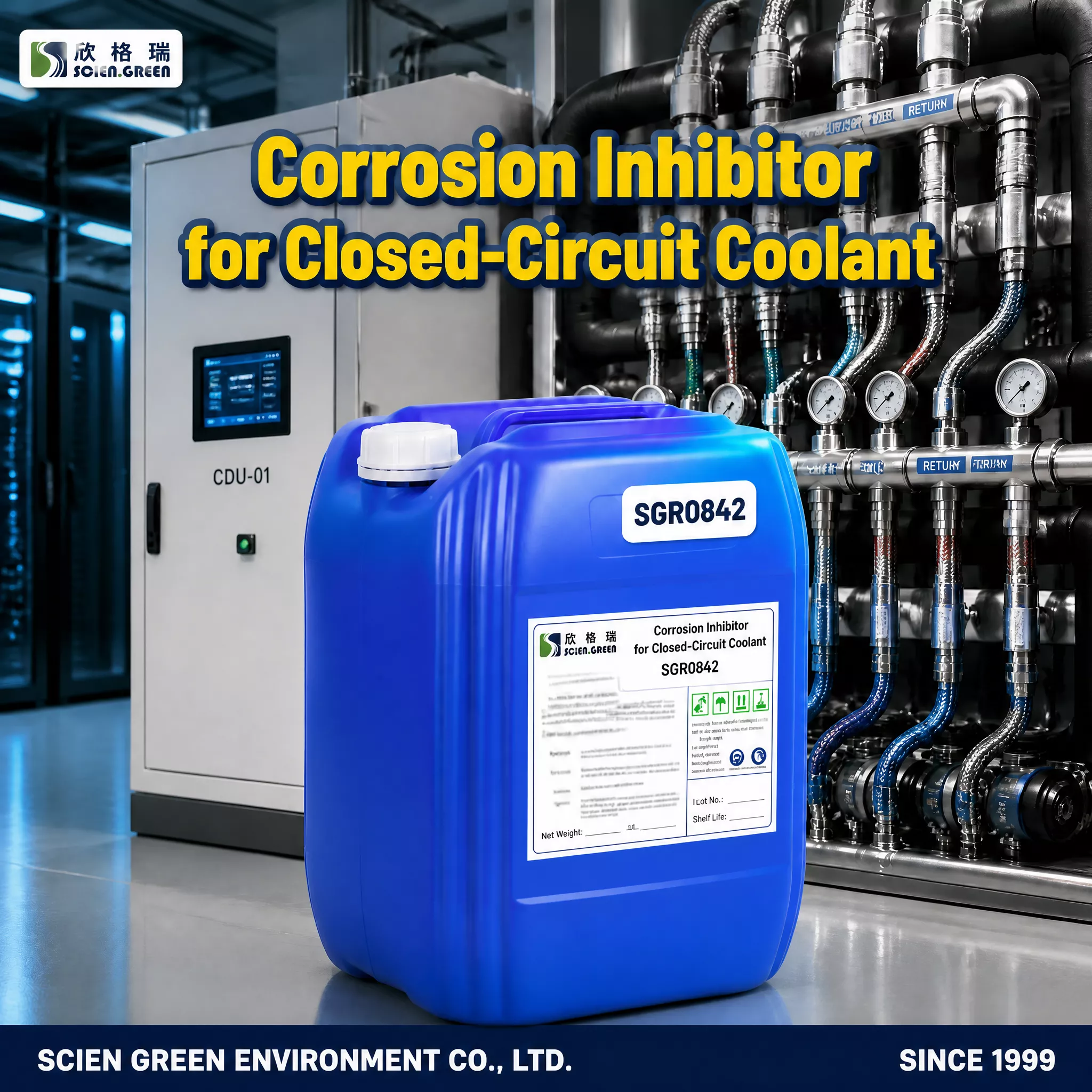
SGR0842 is a specialized, multi-component corrosion inhibitor developed specifically for the primary-side ethylene glycol cooling loops of liquid-cooling Coolant Distribution Unit (CDU) systems in data centers. It is a homogeneous, transparent liquid.
This product is designed to address metal corrosion issues within the primary-side ethylene glycol circulation systems of data center CDUs, including chillers, plate heat exchangers, piping networks, and water pumps. It provides comprehensive protection for common materials used in these systems—such as carbon steel, copper, copper alloys, and stainless steel—by effectively inhibiting chemical corrosion caused by the hydrolysis and acidification of the ethylene glycol medium, as well as galvanic corrosion resulting from the use of multiple, dissimilar metals. SGR0842 significantly enhances the operational stability of the primary-side cooling system, extends the service life of cooling equipment and piping, and reduces both equipment downtime and maintenance costs. It is well-suited for the long-term, continuous operation of high-density liquid-cooling systems in AI computing centers and cloud computing data centers.
Performance Specifications
Appearance | Colorless to pale yellow transparent liquid |
pH (1% aqueous solution) | ≥9 |
Density (20°C) | ≥1.1 g/cm³ |
Solid Content | ≥21% |
II. Applicable Scenarios and Scope of Protection
1. Applicable Systems
Designed for primary-side closed-loop ethylene glycol cooling systems in data center liquid-cooling CDUs, covering the entire circulation loop—from chillers and piping networks to CDU plate heat exchangers. It is suitable for data center environments that require constant-temperature operation year-round, including transitions between winter and summer cooling modes.
2. Protected Materials
Provides effective protection for all standard metal components within the system, including carbon steel piping networks, cast-iron circulating water pumps, copper heat-exchanger tubes in chillers, CDU primary-side plate heat exchangers (made of 304/316L stainless steel), and copper-alloy valves and fittings. 3. Key Performance Advantages
Highly Efficient Corrosion Inhibition: Precisely tailored to the corrosive characteristics of ethylene glycol aqueous solutions, this product achieves an overall corrosion inhibition rate of over 99.8%, effectively preventing pipeline rust, pitting, perforation, and leakage.
Strong Compatibility: Fully compatible with standard industrial ethylene glycol-based coolants; it does not compromise the antifreeze properties of the ethylene glycol, nor does it cause scaling, flocculation, or blockages in heat exchanger channels.
Stable and Long-Lasting: Designed for the continuous, long-term operation typical of data center environments, with excellent chemical stability and persistence.
No Impact on Heat Transfer: The additive does not increase the viscosity of the fluid or form deposits on heat exchanger surfaces, ensuring high-efficiency heat transfer in chillers and CDU (Coolant Distribution Unit) plate heat exchangers, without negatively affecting data center cooling performance.
III. Instructions for Use (Dosing Protocol for the Primary Side of CDU Systems)
The dosage of this product must be calculated based on the total volume of the ethylene glycol aqueous solution in the system. The protocol accounts for different scenarios—new systems, older systems with existing corrosion, and routine maintenance—aligning with standardized data center operations and maintenance (O&M) procedures.
1. Initial Dosing for Newly Installed CDU Cooling Systems
For brand-new, clean, and corrosion-free primary-side ethylene glycol circulation systems, add 2–3 kg of this product per cubic meter of ethylene glycol solution. Calculate the total required amount based on the system's total volume, inject it slowly into the circulation system, and run the circulation pump for at least 30 minutes to ensure the product is thoroughly and uniformly mixed with the coolant.
2. Initial Dosing for Older, Corroded Systems
For CDU primary-side cooling systems that have been in operation for a long time and exhibit minor rust or corrosion, add 5–6 kg of this product per cubic meter of ethylene glycol solution. The dosage may be adjusted appropriately based on the severity of pipeline corrosion or the turbidity of the fluid. Add the full amount at once and ensure thorough circulation and mixing to effectively suppress any residual corrosion risks. 3. Periodic Replenishment
During normal, continuous system operation, the product should be replenished once every four months. The dosage should be 1–2 kg of this product per cubic meter of the ethylene glycol aqueous solution to compensate for any loss and maintain the system’s anti-corrosion performance.
IV. Important Usage Precautions
1. Before adding the product, a comprehensive leak check and any necessary repairs must be completed for the entire primary side of the CDU (Coolant Distribution Unit). Ensure that the piping network, chillers, plate heat exchangers, and water pumps are free of leaks to prevent the loss of coolant and the product, which would compromise anti-corrosion effectiveness.
2. This product is formulated specifically for CDU ethylene glycol systems. Do not mix it with other water treatment agents, corrosion inhibitors, or cleaning agents, as chemical reactions could render the product ineffective or cause the formation of precipitates that may clog equipment.
3. The product must be added while the system is in normal circulation; do not add it while the system is static for extended periods. This ensures the product is evenly distributed throughout the entire cooling circuit.
4. The product does not alter the core properties of the ethylene glycol medium—such as its antifreeze and heat-transfer capabilities—and is compatible with both high- and low-temperature operating conditions. It does not interfere with "free cooling" modes (used in winter) or mechanical (compressor-based) cooling modes (used in summer).
V. Packaging, Storage, and Transportation
Packaging: Available in standard 25 kg plastic drums or 1-ton bulk containers; custom packaging options are also available to meet specific requirements at data center sites.
Storage: Store in a separate, well-ventilated area, away from flammable or combustible materials, reducing agents, and acidic or alkaline chemicals. Do not store with incompatible substances. The storage area must be equipped with emergency spill-response equipment and containment tools to ensure safety.
Transportation: Handle with care during loading and unloading to avoid impact or damage. Ensure that all packaging remains securely sealed throughout transit to prevent leaks that could contaminate equipment or the environment. VI. Safe Handling and Protective Protocols
Personnel performing on-site operations must wear protective eyewear and acid/alkali-resistant gloves. Ensure adequate personal protection; direct skin contact with the chemicals, as well as inhalation through the mouth or nose, is strictly prohibited.
Maintain good ventilation in areas where chemicals are being dosed. Eating or drinking in these areas is strictly forbidden. Upon completion of the work, thoroughly wash hands and any other exposed body parts with soap and water.
In the event of accidental contact with the eyes or skin, flush the affected area continuously with large amounts of water and seek medical attention if necessary.
While this product is neither flammable nor explosive, it must be stored and used in accordance with established regulations. Avoid any improper handling to ensure the operational safety of the facility.


