
 لالعربية


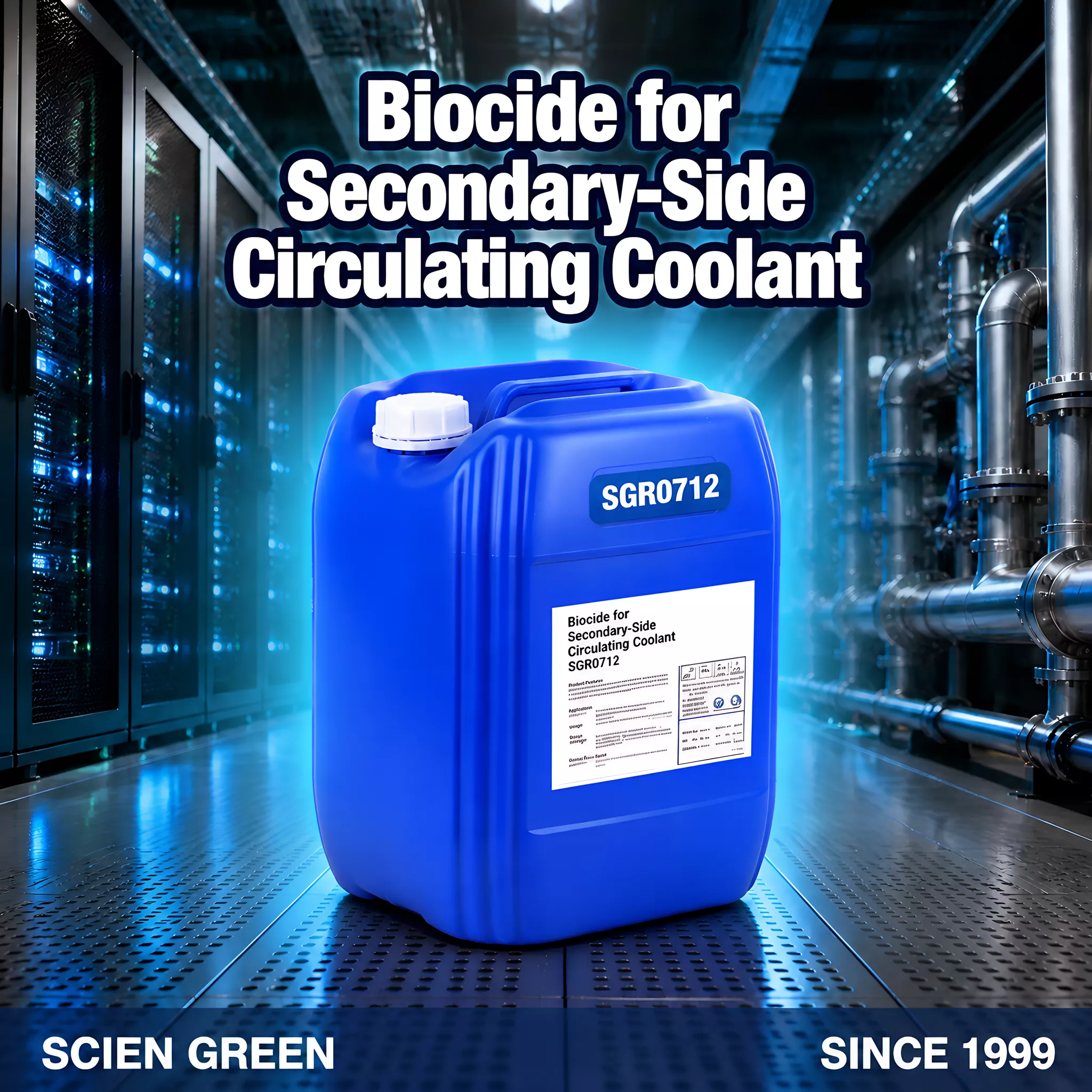
Product Name: Biocide for Secondary-Side Circulating Coolant
Model: SGR0712
Description: This product is a non-oxidizing biocide specifically designed for the secondary-side closed-loop circulating coolant in liquid cooling systems for computing centers. Formulated with high-purity, eco-friendly ingredients—free from hardness ions and inert salts—it serves as a long-acting microbial control agent tailored for high-precision liquid cooling systems that utilize demineralized or softened water. It is optimized for the unique operating conditions of secondary-side closed-loop systems, characterized by an absence of aeration, minimal water loss, and high cleanliness requirements.
Main Ingredients:
5-chloro-2-methyl-4-isothiazolin-3-one, 2-methyl-4-isothiazolin-3-one, and stabilizers.
Physical and Chemical Specifications:
Parameter | Specification |
Appearance | Transparent liquid (pale yellow or pale blue-green) |
Density (20°C) g/cm³ | ≥ 1.03 |
pH (undiluted) | 2.0–5.0 |
Performance:
① Zero hardness and no salt residue; ideal for pure or softened water: The formulation contains no hardness ions, inert salts, or extraneous impurities. This effectively prevents issues common with conventional biocides, such as trace scaling, spikes in electrical conductivity, and water quality degradation, ensuring compliance with the strict water quality standards required for secondary-side closed-loop systems using demineralized or softened water.
② Non-oxidizing, gentle inhibition, and excellent equipment compatibility: As a purely non-oxidizing biocide, it does not damage the existing corrosion-inhibiting or passivating protective films on system components. It is non-corrosive and non-aggressive toward all materials commonly found in liquid cooling systems, including carbon steel, stainless steel, copper, aluminum alloys, and rubber/plastic piping.
③ Broad-spectrum, high-efficiency biocidal action with long-lasting microbial control: Featuring a highly active inhibitory formula, it rapidly eliminates various harmful bacteria, fungi, and slime-forming microorganisms—even at low concentrations—while continuously preventing the formation of biological slime and its adhesion to pipe walls.
④ Excellent Compatibility and Synergistic Protection: Highly compatible with corrosion and scale inhibitors as well as water stabilizers designed for closed-loop systems. It exhibits no antagonistic effects or loss of efficacy, enabling a comprehensive, three-in-one water treatment solution that provides corrosion inhibition, scale prevention, and microbial control.
⑤ Eco-friendly, Low-residue, and Operationally Safe: Free from heavy metals and toxic or hazardous additives. Its decomposition products are harmless, posing no risk of secondary water pollution. It fully complies with the green operation and environmental discharge requirements for data centers and computing facilities.
Applications: Specifically designed for the secondary-side closed-loop cooling systems of liquid-cooled computing facilities and data centers. It is ideally suited for high-purity closed-loop environments that utilize softened water, demineralized water, or purified water as the circulating medium. It is widely applicable to the entire secondary-side infrastructure—including server cold plates, terminal heat-exchange coils, floor distribution piping, plate heat exchangers, and closed-loop circulation pumps—effectively addressing challenges such as the lack of hardness-based buffering in purified water systems, microbial proliferation, biofilm formation, micro-sludge deposition, and minor pipeline blockages. It can also be used in open-loop systems where specific hardness requirements exist.
Usage: Dosing should be calculated precisely based on the total volume of the closed-loop system. For long-term, routine microbial control, maintain a concentration of 200–500 mg/L (0.2–0.5 kg/m³). Since closed-loop systems experience no losses from evaporation or blowdown, the chemical remains effective for an extended period; under normal operating conditions, a single dose per month is sufficient to stabilize water quality and prevent the gradual accumulation and growth of microorganisms. In scenarios such as system restarts after downtime, prolonged high-load operation, the appearance of slight turbidity, or the emergence of biofilms, an "intensified dosing" approach should be applied. Increase the concentration to 500–1000 mg/L (0.5–1.0 kg/m³) and circulate the solution throughout the entire system for 2–4 hours. This will thoroughly eliminate persistent microorganisms and detach weak biofilms from pipe walls; subsequent filtration or blowdown can then rapidly restore the water to a high level of purity. Packaging, Storage, and Transportation: Packaged in 5kg, 25kg, or 200kg plastic drums; store in a cool, dry place.


